Wild teasel
On winter skeletons, perfect cloth, and the subtle genius of the teasel

Over a flawless, green surface, a number of coloured balls lie scattered across a large table. A smartly-dressed man approaches the table with a long stick in hand, methodically rubs the tip on a blue cube, before taking aim at the lone white ball. The stick is called a cue and the balls are snooker balls, and what happens next seems to defy the laws of physics. The cue hits the white ball skillfully, setting the balls in motion as they ricochet off one another, apparently keen on bending their movement to the will of the snooker player. If, like me, you have spent some time watching snooker tournaments on television, you have probably been impressed by the mind-boggling way professional players control the balls with their cues. But have you also paid attention to the impossibly smooth surface on which the game unfolds? That is one of the most remarkable hidden-in-plain-sight details about modern professional sports.
In professional snooker, the playing surface must be absolutely perfect. The exact height, density, and direction of the nap — the fuzz on the fabric — dictate the physics of the entire game. If the nap is uneven by even a fraction of a millimeter, a slow-rolling ball will drift ever so slightly, enough to ruin a player’s shot. To achieve such perfection, professional snooker cloths are exclusively made of the best Merino wool, and the process of raising the nap is still done with natural teasel seed heads. The technique of using teasels to finish cloth dates back to Ancient Rome and became widespread in the Middle Ages, when the wool trade became a backbone of the international economy. Today, the process is heavily automated and relies almost entirely on large machines equipped with specialized metal wire teeth. While these suffice for most everyday fabrics, they still fail to achieve the same results as natural teasel for three main reasons: first, the tiny, elastic hooks on a teasel head are much finer than any steel or nylon wire a machine can draw, separating individual wool fibers at a microscopic level; second, unlike steel wire that may tear a thread when it hits a microscopic knot in the wool, a teasel hook will simply break its own tip off, avoiding catastrophic tears in expensive fabrics; and finally, teasels create a highly uniform, directional nap, allowing players to anticipate friction depending on whether the ball rolls “with” or “against” the nap, helping them achieve that near-perfect control of the cue ball.
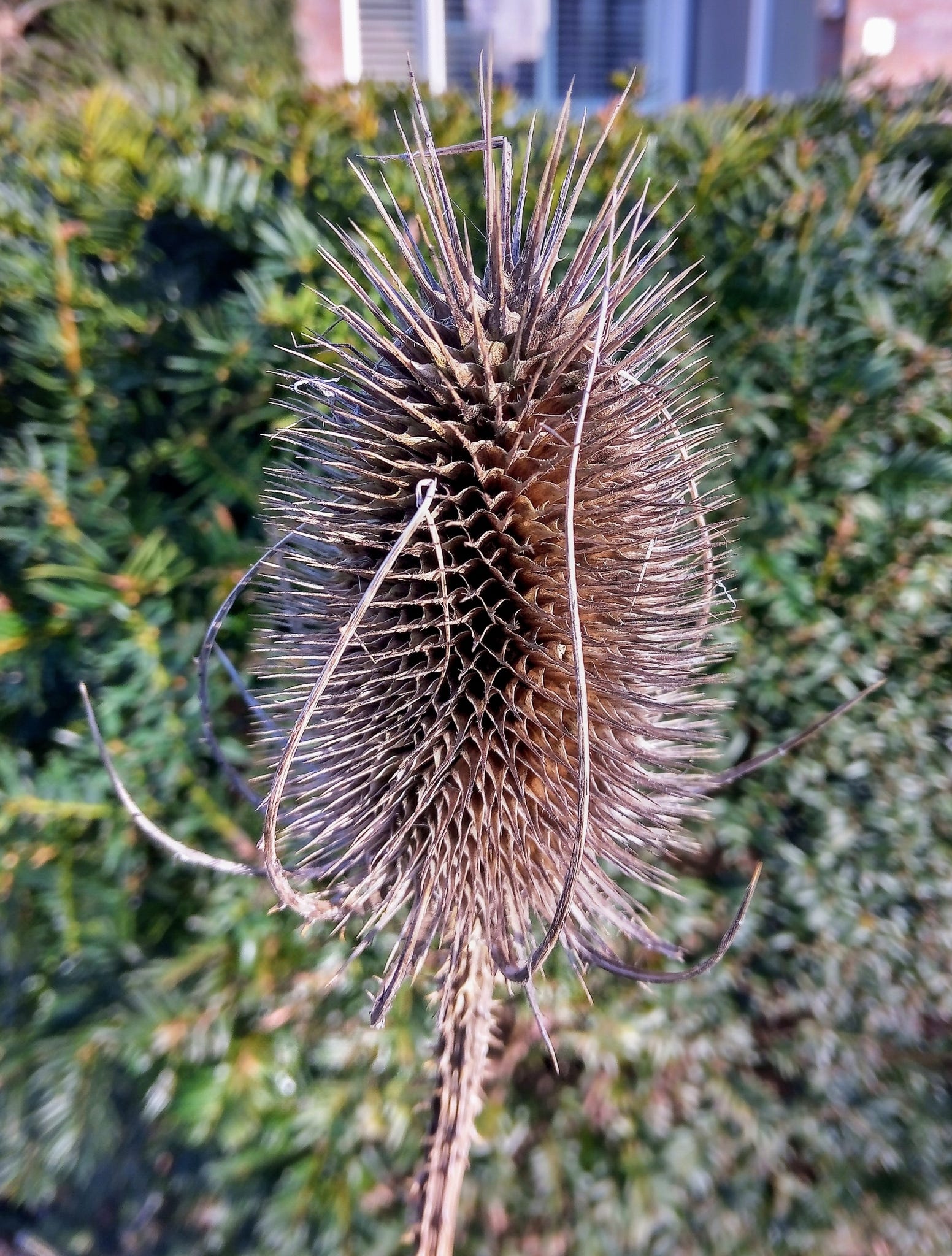
Outside the world of sports, teasel heads are a classic example of the striking winter skeletons left behind by plants after they shed their green summer exuberance in preparation for the darker months of the year. The photo below shows a wild teasel (Dipsacus fullonum) head right here in my neighbourhood, in Groningen, and you can see why gardeners intentionally leave such structures standing through winter. They have a rather exquisite, geometric beauty, look especially striking under a thin layer of snow, and also form a crucial source of food and shelter for birds and insects.
Such sturdy, beautiful structures left behind by plants to endure the winter months tend to fall under three categories: seed heads and cones, pom-poms and umbels, and rattleboxes and pods. Other than the wild teasel, examples of the first group include the cones of the purple coneflower, which often provide a winter buffet for goldfinches; and the silver, golf-ball-sized flower heads of the globe thistles, which look like miniature engineered spheres. Among the second group are the beautiful papery, sepia-toned, flat flower heads of hydrangeas, which remain intact on the woody stems all winter long, holding tiny caps of snow; as well as the massive, exploding-star spheres of the giant alliums, which dry out into delicate, see-through, tawny cages that look like whimsical architectural wire structures dotting the winter landscape. Finally, plants like the evening primrose leave behind tall, woody stalks lined with neat, split-open seed pods that local birds rely on during the coldest months and also provide overwintering cavities for native solitary bees; while the wild indigo produces pea-like seed pods that turn a dramatic, inky charcoal black and rattle as the wind shakes the seeds inside.
The wild teasel is also known as fuller’s teasel, although the latter name is usually applied to the cultivated variety that is used for raising the nap of high-end fabrics. The species is native to Europe and North Africa, but has also been introduced to the Americas, southern Africa, Australia and New Zealand due to its value for textile processing, where in some regions it has become a noxious invasive weed. It’s an herbaceous biennial plant, meaning it takes two years to complete its life cycle, and can grow up to 2,5 metres tall. The leaves are lanceolate and 20 to 40 cm long, while the inflorescence forms a cylindrical head of lavender flowers at the tip of the stem. The seeds are an important winter food resource for some birds, notably the European goldfinch.
If you look closely at where a teasel’s leaves meet its stem, you may notice that they fuse together to form a deep, water-tight cup. When it rains, these cups fill up with water and inevitably become watery graves for ants, flies, and beetles, which led 19th-century botanist Francis Darwin — one of the sons of the great Charles Darwin — to propose that the plant was carnivorous. There has been a great debate ever since over this theory, but more recent research suggests that those water cups are essentially defensive moats against sap-sucking insects. The plant has no means to lure insects into the water, nor does it secrete any enzymes to break down its presumed prey. While it may opportunistically soak up a tiny bit of nitrogen as nutrients leach from a decomposing insect, this is likely an accidental bonus, as studies have found that teasel growth and reproduction are entirely dependent on soil nutrients.
So, while Francis Darwin may have been wrong about the wild teasel’s appetite for flesh, he was entirely right to be captivated by this plant. It need not be carnivorous to deserve our fascination. Standing alongside faded hydrangea flowers, rattling wild indigo pods, and many other beautiful plant structures that punctuate the barren winter landscape, the teasel is a reminder that the natural world never ceases to amaze. Beyond its rich history in human industry, its geometric beauty, and its clever defensive moats, it just needs a little touch of winter frost to show off how beautiful plants can be, even in the dead of winter.
If you enjoyed reading about teasels and their role in sports, gardening and industry, consider buying me a coffee to support my work.
Fascinating! As a knitter and fiber artist, I can’t believe I didn’t know the “industrial” uses of teasel! Where I live now, I haven’t seen any teasel, but it had found its way into some parks and wetland areas of both Seattle and Portland where I’ve seen it trail side. Thanks for this glorious look at an overlooked plant friend.
Fascinating facts- and all beautifully written, Pedro.
My mother used to love the teasel- she adored its winter form and the way the wild birds found winter sustenance from them. They are a classic winter form- one of my favourites alongside urn-shaped poppy seedpods.