Sanderling
Shorebirds, the energetic dancers of the coastal areas

I don’t remember the exact words anymore, and they were uttered in Portuguese, but the biologist said something like “what a beautiful, wonderful animal”, after which he briefly kissed it and proceeded to explain that the bird in his hands — a red knot — had come there all the way from the High Arctic, maybe northern Russia, northern Greenland, or even northern Canada, where it breeds in the tundra regions around the Arctic Ocean. I was an undergraduate at the time and this was one of my first shorebird ringing sessions. Even though I later participated in many, many more — spanning at least seven countries — these sessions never lost their aura of otherworldliness and quiet amazement.
There are many ways to catch shorebirds for research, from setting traps they can walk into to literally using cannons to shoot nets over them, but the one I am most familiar with is the use of so-called mist nets. These are thin, dark nets suspended from two vertical poles and divided horizontally by strong strings holding pockets of slackening net where birds can fall and become tangled. To catch shorebirds with such nets, you have to do it at night, preferably on nights with little or no moonlight when the nets are rendered invisible by the darkness, and set them in places where you know the birds will flock, such as roosting sites.
That is what we were doing that night, in a saltmarsh on the southern shore of the Tejo estuary, with the glaring lights of Lisbon well visible across the water. We arrived during low tide, while all birds were away foraging, set the nets — with any luck, still during daylight — and then started the waiting game. As the tide rose and birds started moving into the saltmarsh to roost, we started visiting the nets about once every hour. These visits can’t be too close together, to avoid scaring off our visitors, nor too far apart lest a bird suffer harm from being tangled in the net too long. We walked in single file, in complete darkness, along a muddy, winding path across the saltmarsh, our chest waders keeping us dry, but failing miserably at keeping out the chill of the January night. We would only turn on our headlamps in case of dire need. After a few hundred meters we reached the poles — barely visible in the dark — and started walking the length of the nets looking for small dark lumps hanging above the muddy surface.
Each of these lumps was a bird tangled in one of the pockets of the net, its weight pulling it down and making the mesh slightly visible amidst the darkness. What happened next was nothing short of magic, even if later I came to learn myself how to cast that spell. Just by touch, without resorting to any light, the biologists would first feel on which side of the net the bird was, and then proceed to gently remove it from the tangled mesh. First the long legs, then the head and bill, and finally the long, slender wings that had carried the bird across countless kilometers. With more or less difficulty, each one would be removed from the net and placed in a small cloth bag. If we were lucky, we returned from the net with our arms heavy with such bags, and then efficiently moved each bird into cardboard boxes where they could stretch their legs until the time came to ring and measure them under the torchlight. Sometimes, one was already wearing a ring, from Denmark, Sweden, or even further away. Evidence of the vast migratory movements undertaken by these birds that sometimes weighed less than a plum. Afterwards came everyone’s favourite moment, when we could release the birds again to freedom. Those sessions often lasted the whole night. We would leave the place as the day was breaking, exhausted but happy from a job well done.
Shorebirds have a special charm to them. Maybe it’s their calm nature, their elegant bodies, or their extraordinary migrations. One way or another, they will always have a special place in my heart. Dunlins, plovers, redshanks, godwits, turnstones, knots, avocets and others, every single one a line of poetry in a body perfectly designed for flight. To experience them, we need to visit tidal areas. Estuaries, coastal lagoons, beaches — it’s where the water flows and ebbs under the effect of the moon that these birds spend their winter. As the tide starts to go out, a quiet choreography unfolds. They often arrive in small groups from their high-tide roosts and promptly start looking for food, pecking the mud in search of worms, bivalves and crustaceans. As the tide goes out, so do the majority of shorebirds, following the water’s edge further and further away from the coast. It’s there that the prime buffet is located: prey that haven’t yet had time to bury too deep, a thin film of remaining water that helps them spot their prey, and the softer mud that is easier to probe. A few hours later, when the rising tide approaches the coast again, so does the quiet ballet of foraging shorebirds, busy getting all the prey they can get before their dinner table is fully submerged.
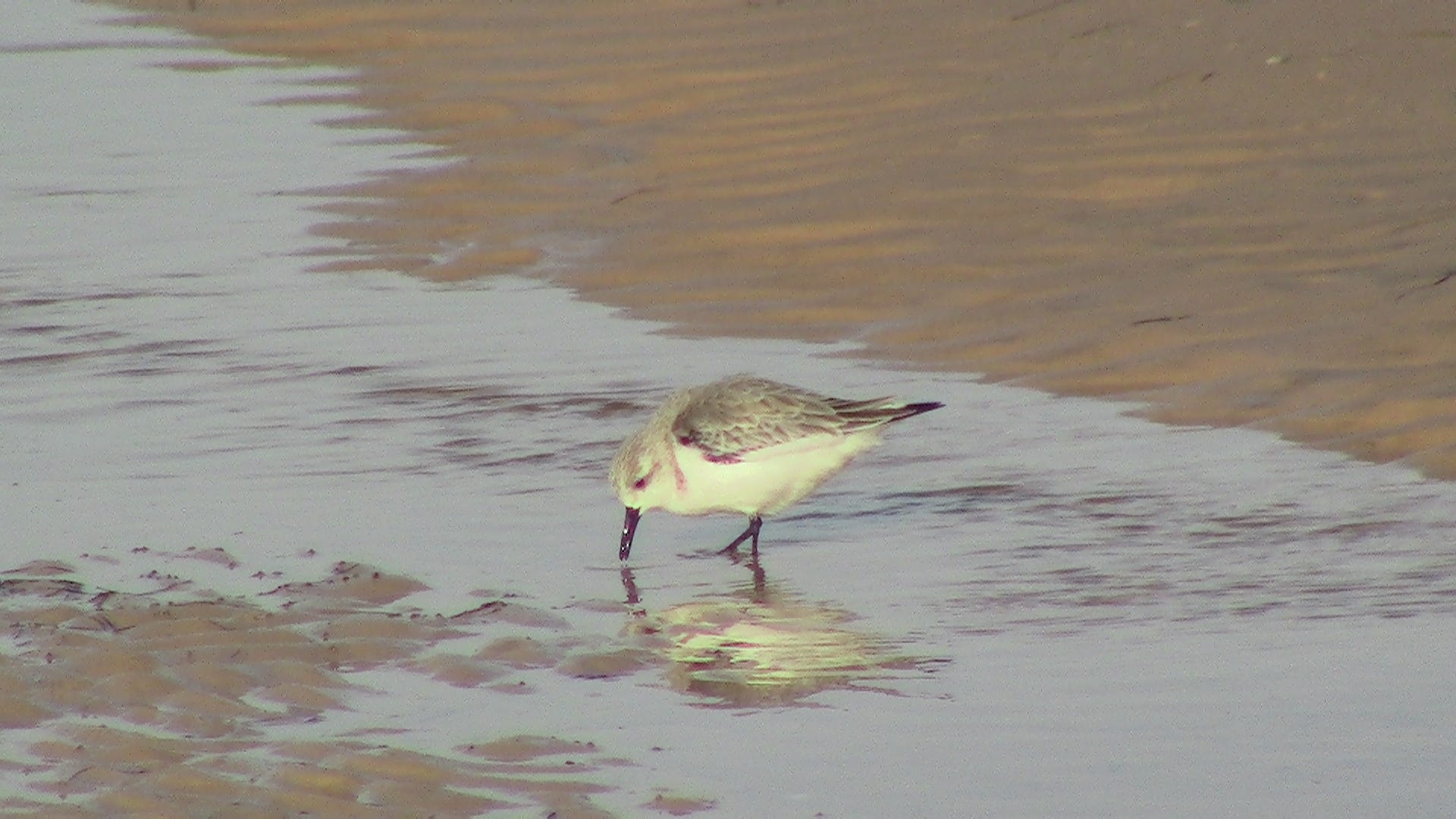
On the open coast, the story is similar, but the slow movement of the tide is masked by the much more visible action of the waves. That is where you will find the sanderling, an expert wave-follower and wave-dodger that sprints up and down the beach in search of tiny marine animals briefly exposed by the action of waves. You usually see them in small groups, their white bellies and light grey backs giving them the appearance of foam flakes blown by the wind. Even if their tiny legs move unbelievably fast — using slow motion footage I have measured step rates of up to 700 per minute — they sometimes still need to fly off to avoid the crashing of a faster wave. Spend a few minutes enjoying the antics of a flock of sanderlings and you will feel like you just completed a workout yourself.
Sanderlings breed in the High Arctic tundra of Canada, Greenland, Svalbard and Siberia, but outside the breeding season they can be found along all the coastlines of the world, except in Antarctica. They are mainly found on sandy beaches and have a special adaptation for running over sand that makes them different from all other shorebirds: they have completely lost their hind toe — the hallux — leaving them with only three forward-facing toes. This characteristic, which gave rise to their Dutch name drieteenstrandloper (”three-toed sandpiper”), prevents the hind toe from dragging or catching on the uneven, shifting grains of sand, allowing the bird to more easily shift its weight. This facilitates the iconic sprints and lightning-fast turns of sanderlings as they chase and avoid the waves.
The vast wintering range of the sanderling means this species can spend its non-breeding period facing dramatically different weather conditions. Just along the East Atlantic, some sanderlings may spend the winter along the North Sea coast, where negative temperatures and frozen waters are not unusual; in southern Europe or North Africa where the winter is mostly mild; or in the tropical coast of the Gulf of Guinea, where the weather stays hot all year round. Since, like all birds, they are warm-blooded and maintain a constant body temperature of about 41°C to 42°C, this means the birds wintering further north must spend quite some energy to stay warm, and therefore must eat far more food than their tropical counterparts to sustain this intense thermoregulatory activity.
Next time you stop by a beach or tidal flat in the winter and watch the intricate ballet of the foraging shorebirds, take a moment to appreciate what it must be like to constantly have to forage just to stay alive. If these happen to be sanderlings on a northern beach, the birds in front of you are literally running for their lives. And even when spring comes and the weather becomes more merciful, there is no respite for these marathoners of the natural world, for they will now have to speed up their foraging to accumulate sufficient reserves to fuel the vast migratory flights they must undertake to reach the distant tundras where they will raise the next generation of their species. Whether shivering in the northern gales or basking in tropical heat, these tiny, feathered dynamos connect the four corners of the world in one long, graceful dance of survival.
If you enjoyed reading about sanderlings and other shorebirds, consider buying me a coffee to support my work.
Beautiful, poetic writing. Your deep love of the natural world shines through in everything you do. Thank you!
I love spotting Sanderlings when i go to the coast and boy are they fast. They have often been referred to in groups i have been as little clockwork birds. I always presumed this was in reference to those mechanical toys you wind up and then release is this correct?