Common toad
Night wanderers moving slowly across dark, damp roads

If you are driving at night on a quiet, dark country road and the car in front of you seems to be slowly zigzagging all over the road, that usually means one of two things: either the other driver had a bit too much to drink and is finding it hard to follow the road, or the amphibians are on the march. While the first scenario is a cause for concern, the second is a sign of a rare and fleeting biological drama. Those swerving headlights are often the only thing standing between a successful migration and a very flat ending for animals caught between two worlds.
As the name indicates, amphibians are animals that live a double life — from the Greek amphi, meaning “both” or “double”, and bios, meaning “life” — part in the water and part on land. They need water to reproduce, usually laying their jelly-like eggs in the water and living underwater during the initial, larval stage of their lives; and their skin is moist and permeable, which means that if they stay out of water for too long, they run the risk of drying out. However, they often forage on land and need to cross land to move between different ponds, to escape watersheds that have dried out, or to find places to hibernate. This means that when conditions are just right, you might find lots of amphibians on the move, and when a road lies between them and their goal, there they will be, hopping or crawling and too slow to avoid the incoming traffic.
Since amphibians are not fully adapted to life outside water, namely due to their semi-permeable skin, their movements are dictated by moisture and temperature. They prefer nights with light, steady rain or very high humidity, and the temperature needs to be at least 5°C to 10°C. Warm, wet nights after a cold snap are when amphibian migration usually peaks, especially in spring when they emerge from hibernation looking for a pond or river to hunt and breed, and in autumn when they are looking for burrows or deep soil to hibernate. Such nights can be quite spectacular, but you need to be extremely careful to avoid running them over.
It’s not so hard to find a few frogs and toads on a road when conditions are right, but the very intense migrations when the whole road is riddled with them are quite rare. In fact, I only witnessed this once in my life. It was in Portugal, on a dark road near the town of Amareleja, during a rainy autumn night after a long, hot, dry summer. On a section of just a couple kilometres we found dozens and dozens of frogs, toads, newts and salamanders, and had to drive incredibly slowly to avoid them. It was a great opportunity to see how diverse amphibians can be. We saw large fire salamanders (Salamandra salamandra), bulky creatures with a long tail and stunning black skin with bright yellow spots; marbled newts (Triturus marmoratus), more slender than the salamanders, with an irregular pattern of greens and dark browns and an orange stripe running down their back and tails; Iberian green frogs (Pelophylax perezi), tailless and long-legged with smooth skin and mostly green bodies; and common toads (Bufo bufo), bulky and brown with their skin covered in warts.
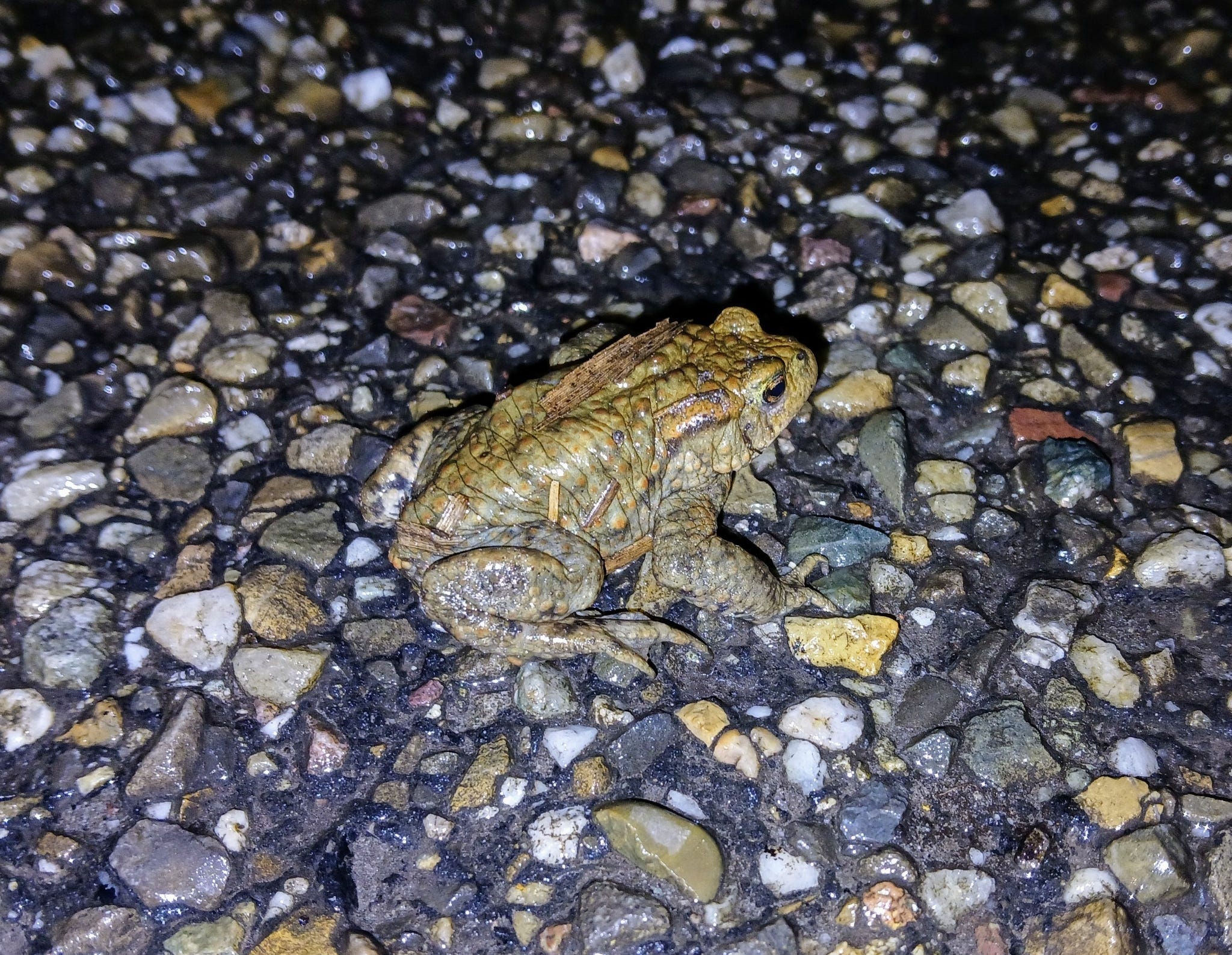
Here, in the Netherlands, the common toad is also quite abundant and I’ve seen them often on roads, as well as simply hiding behind the rubbish bin in my front yard. The one in the photo below was photographed near the town of Harkstede, on a moist night when the headlights of our car offered us several sightings of common toads, each time giving me and the kids the opportunity to jump out of the car and take a closer look at such peculiar animals. Try going out at night when the conditions are right for amphibians, and you may well get up close and personal with the common toad.
One of the first things you might notice is that toads don’t hop like frogs. They have shorter back legs and a heavy body, making them relatively poor jumpers. Instead, they prefer a slow, methodical crawl or a very small, clumsy hop. Although you can spot common toads almost anywhere, they are hardly the kind to wander aimlessly. They have an incredibly strong homing instinct that leads them back to the exact same original pond where they were born, year after year. Even if a new, perfectly good pond is built closer to them, they will often bypass it and risk crossing dangerous roads to reach their original home. They are also surprisingly long-lived. In the wild they typically live around 10 to 12 years, but in captivity they have been known to reach the ripe old age of 50 years.
For a small animal like a toad to live so long in a world full of predators that would love to make it a snack, it must have some tricks up its sleeve. Actually these tricks are not in any sleeves, but on the back of their heads. Common toads don’t have teeth or claws for defense, so they rely on chemical warfare. The two large bumps behind their eyes are parotoid glands. When a toad is threatened, these glands secrete bufotoxin, a noxious substance that tastes bitter and can be lethal to small animals. This toxin is also present in their tadpoles, which allows them to survive in deep ponds filled with fish that would otherwise find them delicious.
Although common toads are mostly harmless, their warty appearance and nocturnal habits have long earned them an association with the devil and witchcraft. John Milton depicted Satan as a toad in his classic Paradise lost, and in the Middle Ages people invented a coat of arms for the devil which bore three toads over a red background. Witches supposedly used toads as ingredients in their brews and finding a toad in a house was considered evidence that a witch was present. One of the witches in Shakespeare’s Macbeth even gave specific instructions on how to use a toad for the concoction of spells.
Personally, I don’t find them the least bit demonic and even think amphibians in general are quite charming animals. It’s a pleasure to see them hopping and crawling about, living testaments to a time long gone when life had just figured out a way out of the primordial waters where it originated. If you make the effort to visit them in their world, in ponds, slow-flowing rivers, moist nights and shadowy forest floors, spotting amphibians can be easy and a very rewarding experience. They often allow you to get quite close and see them in great detail. To look into the gold-flecked eye of a toad is to look back through eons of history. They are the great survivors, bridging the gap between the water that birthed us and the land we now call home. By slowing down on those dark, damp nights and making room for their journeys, we ensure that these quiet night wanderers continue their march — not just across the road, but through the centuries to come.
If you enjoy these small wanderings through the wild, you can help keep them brewing — one coffee at a time.
Great read Pedro, both frogs and toads are becoming scarce in parts of the UK.
Also in the UK there is a third reason for swerving in your vehicle on the highway. Our highways authorities rarely mend roads these days so they a full of potholes.
Amazing information, thanks so much for sharing!!! I don’t think I have ever seen a toad here in northern Romania, maybe once or twice… Sometimes I notice a frog down by the creek or smashed on the road. It’s interesting to think how, though we do live in a rural area, there is very little wildlife to be seen…